
When the Veil Thins: What MTG and Candace Owens Reveal About the Collapse of the Political Industrial Complex

This week, two very different public figures —a sitting U.S. Congresswoman and a global media personality —released statements that shook the political world within hours of each other. Not because of the politics attached to their names, but because of what their words signaled:

A fracture.

A breaking point.

A confession of something deeper happening beneath the surface.

Marjorie Taylor Greene, one of the most polarizing members of Congress, posted a five-page resignation letter announcing that her final day in office will be January 5th, 2026. Her language wasn’t the typical “I’m stepping down to spend more time with my family.” It was something else. Something raw. Something that sounded like a person who finally stopped pretending.

She wrote of betrayal, targeting, the political industrial complex, and the machine in Washington that “devours” anyone who refuses to obey it. She spoke of foreign influence, elite donor classes, Big Pharma, Big Tech, and the Military Industrial Complex controlling what should be the people’s house. She described years of being used as a political weapon, discarded, and threatened by the very structure she once defended.

And then, hours later, Candace Owens published a statement so shocking that even her critics had to pause. She claimed a high-ranking French government insider warned her that her assassination had been greenlit by Macron, carried out through specialized military units. Whether one believes this claim is beside the point … the real message was in the tone:

“If something happens to me, I want the world to know.”

“Let all be revealed.”

Two different women.

Two different spheres.

One shared thread:

The machine is cracking.

And the people inside it are finally saying it out loud.

This is not about agreeing with them.

It’s about recognizing the pattern.

We are living in a moment where the institutions that held power for decades — political parties, media giants, intelligence agencies, international alliances — are no longer able to maintain the illusion of unity, morality, or control. The people who once benefitted from these institutions are now calling them out. And not subtly.

They’re saying the quiet part loudly.

They’re saying what many ordinary Americans have felt for years:

There is a ruling class. And they’ve stopped pretending they work for us.

A Veil is Lifting — Politically and Spiritually

What’s happening right now is exactly what I’ve been writing about in The Lost Path to Freedom. You cannot build an empire on deception forever. Eventually the weight of its own corruption collapses inward — and the people who were once its most loyal defenders become unwilling witnesses.

Truth doesn’t rise quietly. It rips seams open.

This is not about left or right.

It’s not about Republican or Democrat.

It’s about the end of an era where political power operated in the shadows while the public was given a scripted performance.

The veil is thinning — spiritually, socially, politically.

And people are sensing it.

Fear is the First Stage of Revelation

When systems collapse, the people inside them often panic. They lash out. They reveal secrets. They say things they once would have buried to protect their careers.

They tell the truth because the truth has become safer than silence.

That is the energy we are seeing now:

Panic mixed with confession.

Fear mixed with revelation.

Power mixed with collapse.

This doesn’t mean we are doomed — it means the opposite.

Corruption is exposed right before it loses its hold.

When someone shows you the machinery behind the curtain, it is because the curtain is already burning.

The political industrial complex — the same one MTG named directly — is not invincible. It is decaying. It is being seen. And once something is seen, it cannot return to the shadows.

This is a moment of collective awakening.

Not just politically, but spiritually.

We are watching the same story that has played out across civilizations:

• The old guard grips tighter.

• The people grow restless.

• The truth leaks through unintended cracks.

• The empire, in its arrogance, exposes itself.

• And in the collapse — new paths open.

This is not the end of America.

This is the end of pretending.

And that, in a strange way, is freedom.

Let all be revealed.

And let us keep walking the path back to truth, back to integrity, back to what was lost and is now returning.

The people are waking up.

The systems are shaking.

And the truth — finally — is speaking for itself.

Before Constantine: The Real Origin of “Synagogue of Satan”

By Julie Tourangeau | julietour.com

Why Modern 2000s Christian Churches Got This Wrong and Why the Truth Sets Us Free

If you’ve spent any time around modern 2000s-era Christian churches influenced by the Seven Mountain Mandate, you’ve likely heard a very confident claim: that the phrase “synagogue of Satan” in Revelation was manipulated, shaped, or inserted by Constantine.

It sounds compelling.

It feels dramatic.

But it’s historically impossible.

The Seven Mountain Mandate is just empire wearing a cross, power disguised as prophecy, hierarchy masquerading as holiness.

Many modern churches shaped by the Seven Mountain Mandate have built an entire theology on fear, control, and the belief that Christians must “take over” cultural institutions to usher in God’s kingdom. This movement often rewrites history to fit its agenda claiming, for example, that terms like “synagogue of Satan” were manipulated by Constantine or created by later political conspiracies. But none of this is supported by actual history, early manuscripts, or the lived spirituality of the first followers of Jesus. The Seven Mountain Mandate replaces Jesus’ nonviolent, compassion-rooted Way with a dominionist system obsessed with power, hierarchy, and cultural domination. In doing so, it distorts Scripture, promotes fear-based interpretations, and encourages believers to see enemies where Jesus saw human beings in need of healing, mercy, and awakening. Recovering the real history frees us from these modern distortions and brings us back to the original, liberating message of Christ: that the kingdom is within, not seized through political conquest.

The more closely you study early Christianity, the more obvious it becomes:

Constantine wasn’t even alive when Revelation was written.

The phrase predates him by almost 200 years.

And its meaning comes from Jesus’ own spiritual lineage, not from Rome.

This matters…not just for accuracy, but because reclaiming the original meaning frees us from the fear-based, empire-influenced theology that still shapes American Christianity today.

Let’s look at the real history.

Revelation Was Written Long Before Constantine

Revelation was composed around 90–96 A.D.

Constantine was born in 272 A.D.

The phrase “synagogue of Satan” appears in:

• Revelation 2:9

• Revelation 3:9

That’s it.

No later additions.

No Roman edits.

We possess physical manuscripts and quotations from before Constantine existed that contain these verses.

This alone breaks the Seven Mountain Mandate narrative.

The Phrase Comes From a Much Older Jewish Tradition

“Synagogue of Satan” isn’t Roman language at all.

It’s Jewish sectarian language rooted in the Essenes and the Dead Sea Scrolls.

If you’ve ever read the Scrolls, you instantly recognize the pattern:

• “men of the pit”

• “lot of Belial”

• “congregation of deceit”

• “sons of darkness”

These are spiritual classifications describing groups aligned with corruption rather than God.

This exact dualistic moral vocabulary appears in:

• the Dead Sea Scrolls (150 B.C.–50 A.D.)

• Jesus’ teachings

• Paul’s letters

• the Book of Revelation

Which means:

The language used in Revelation is older than both Constantine and Christianity itself.

Jesus Himself Spoke Like an Essene

Whether or not Jesus was formally Essene, His teaching vocabulary mirrors theirs:

• “children of light”

• “evil one”

• “your father, the adversary”

• “wolves in sheep’s clothing”

• “den of violent ones” (mistranslated as “robbers”)

• “blind guides”

This is the same symbolic worldview Revelation uses.

It is emphatically not Roman, imperial, or Constantinian.

It is Jewish, prophetic, and nonviolent.

Early Church Fathers Quote the Phrase Before Constantine

Another inconvenient fact for modern prophecy churches:

Writers who lived long before Constantine quote Revelation — including the “synagogue of Satan” passages — exactly as we have them today.

• Ignatius of Antioch (c. 110 A.D.)

• Justin Martyr (150 A.D.)

• Irenaeus (180 A.D.)

Irenaeus even reproduces material from Revelation 2–3 directly.

This proves:

• the text was stable

• the phrase already existed

• Constantine didn’t insert anything

That’s not speculation.

It’s archaeology.

What Constantine Actually Changed … And What He Didn’t

Constantine changed:

• Christianity’s political status

• the structure of the church

• the relationship between bishops and empire

… he even united pagans and Christians by combining certain aspects of each faith for holidays.

But he did not:

• influence Essene vocabulary

• change first-century Jewish symbolism

The claim that he created “synagogue of Satan” language is simply not factually possible.

The Real Meaning of “Synagogue of Satan”

Once you remove modern distortion, the meaning becomes beautifully simple:

“Synagogue of Satan” means

an assembly aligned with injustice or spiritual blindness — not an ethnicity.

It does not mean:

• Jews

• synagogues

• ethnic groups

• political states

• religious institutions

It means:

any community whose actions oppose compassion, justice, and sacred consciousness.

This aligns perfectly with:

• the Essenes

• Jesus

• Paul

• Revelation

• and the whole apocalyptic tradition of ancient Judaism

It is not about identity.

It is about alignment.

Why This Matters Today

Many 2000s-era prophecy churches teach a theology shaped by:

• the Seven Mountain Mandate

• 20th-century Zionist politics

• 19th-century dispensationalism

• anti-historical end-times charts

• fear-based spiritual warfare language

These systems tend to make Constantine the villain behind every biblical “hard saying.”

But the truth is far more grounded:

The ancient followers of Jesus were speaking from within their own Jewish tradition —

not reacting to a fourth-century Roman emperor.

When we return to the real roots, we rediscover the spiritual brilliance of the early Jesus movement:

• truth over distortion

• compassion over fear

• awakening over control

• inner liberation over outer empire

• justice over violence

This is the Jesus whose teachings were hijacked by empire, but not created by it.

And this is the Revelation written long before Constantine, calling communities to walk in light, love, and discernment.

Because “synagogue of Satan” was never about a people.

It was always about a posture.

It was always about a choice.

It was always about a community’s alignment with compassion or with injustice.

And that message is more relevant today than ever.

The Women, the Wisdom, and the Animals: What We Forgot About Easter

By Julie Tourangeau | Good Friday, 2025

Before the tomb was empty…

before the stone was rolled away…

before the anointing and the rising and the glory…

there was a moment we rarely talk about.

And it didn’t happen on a hill.

It happened in the Temple.

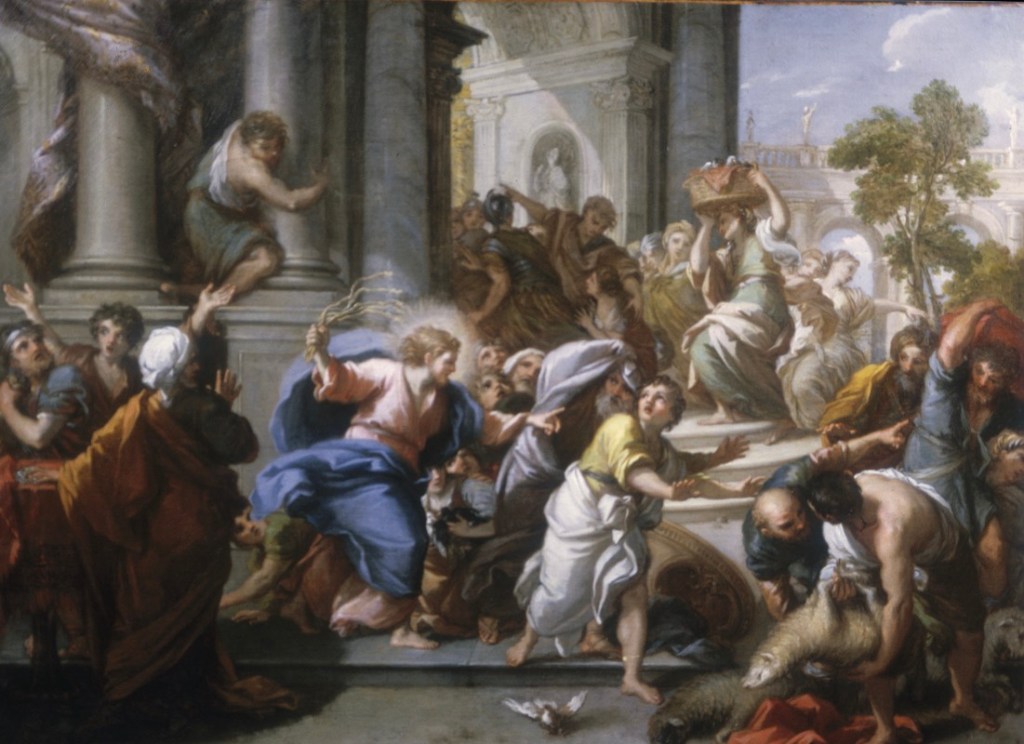
It was there that Jesus walked in, looked around, and did what no one else dared:

He freed the animals.

The Cleansing of the Temple Was a Liberation

All four canonical gospels record the Temple cleansing, but what most people miss is why it mattered so much.

Jesus didn’t just flip tables to make a scene.

He drove out the sellers of doves. He freed the lambs and oxen being sold for sacrifice.

According to the Gospel of the Nazarenes, a lost early gospel aligned with the Essenes:

“He drove out the animals and said, ‘Cease your wicked sacrifices! Do you not see that innocent blood cries out from the earth?’”

In that moment, Jesus publicly rejected the sacrificial system—a system that normalized bloodshed and called it holy. He saw through the illusion of substitutionary violence and revealed the deeper truth:

The Holy Spirit is not found in the shedding of blood, but in the honoring of life.

And from that moment on, the system moved to silence him.

The First Step Toward Resurrection Was Setting the Innocent Free

Let this sink in:

It wasn’t the miracles that got Jesus killed.

It wasn’t the healings or the parables or even claiming to be the Son of God.

It was the moment he freed the animals that the wheels of execution began to turn.

This was the turning point—not just in his story, but in ours.

Because Jesus wasn’t just liberating animals. He was exposing a system—religious, economic, cultural—that had come to depend on suffering.

And he showed us what it looks like to say:

No more.

The Divine Feminine Knew

Many people associate Easter with the idea that Jesus died to pay for our sins—but that interpretation came later. The earliest followers of Jesus saw his life and death not as a blood payment, but as a revelation of divine love and a call to awaken the Christ within. Texts like The Gospel of the Holy Twelve remind us that his suffering was not about appeasing wrath, but about healing hearts, breaking chains, and showing us the path of compassion, even in the face of injustice.

What followed was suffering, yes—but also sacred initiation. And through it all, the ones who stayed near were not the theologians or temple authorities. It was the women.

Grief was his first initiation, through Miriam, the young woman with whom Jesus lived for seven years before her death. According to The Gospel of the Holy Twelve, it was her passing that opened his heart to the deeper path. According to this gospel, « Grief didn’t weaken him. It awakened him. »

Before knowing about this grief story of Jesus, I wrote about my own:

“Without my dark night of the soul, and without having challenging circumstances, I wouldn’t have grown my blessings… Painful change is sometimes exactly what we need to shake things up. Living through trauma, family drama, and the grief of losing a loved one can feel almost like an endless dark tunnel… Grief is just love with seemingly no place to go, but when you realize love shared is eternal, you can finally let go of the pain and gain the wisdom that is rightly yours.” — Free Yourself from Grief, Chapter 5

Compassion was his final anointing, through Mary Magdalene—not a sinner, but a priestess. She anointed his feet, honoring him with a sacred rite passed down through feminine lineages.

And when he was crucified, it was Magdalene who remained. While the male disciples fled, she stood at the cross, and three days later, she was the first to see him risen.

The resurrection was not first revealed to Rome or religion. It was revealed to her.

And wisdom—Sophia—was the soul behind it all.

The Spirit of God that hovered over the waters in Genesis.

The voice crying out in the streets in Proverbs.

The divine spark in all life, calling us home.

What if Easter was just the beginning?

While many see the resurrection as the end of Jesus’ story, ancient traditions—especially in southern France—tell a different tale. According to Provençal legend, Mary Magdalene journeyed to France after the crucifixion, carrying not only the memory of Jesus but the living essence of his teachings. Some say she preached love and liberation from a cave near Sainte-Baume, others believe she brought with her the sacred feminine that was erased from the official story. The Holy Grail Legends say she brought his bloodline to France, and they still walk Earth among us to this very day.

Easter Is the Unveiling of Compassion

This Easter, I invite you to see the resurrection not as a distant miracle, but a living pattern.

The pattern begins with letting go of violence.

It moves through grief.

It is held by the feminine.

And it ends in freedom—not just for ourselves, but for all of creation.

Resurrection isn’t just rising from the dead.

It’s refusing to live by death.

It’s refusing to justify harm.

It’s the choice to let the doves go free.

To Walk the Lost Path to Freedom This Easter Is To Remember:

• The animals were the first to be freed.

• The women were the first to understand.

• Sophia is the wisdom that lives in you.

• The Holy Spirit is the breath that animates all life.

• And love is not proven through suffering, but through liberation.

This Easter, may we not just celebrate a risen Christ,

but live like him.

May we be the ones who open the cages,

who hold the grief,

who anoint the new day.

May we rise—not above the world, but for it.

Free the animals.

Free the heart.

And the stone will roll away.

The Rapture That Wasn’t: Why Early Christians Didn’t Believe in Escaping Earth

BREAKING: RAPTURE RESCHEDULED DUE TO SUPPLY CHAIN ISSUES

Heavenly sources confirm that the long-awaited rapture has been delayed again—this time due to a shortage of cloud fuel and insufficient harp inventory.

An anonymous angelic spokesperson said, “We’re still trying to get the golden escalators functioning. Also, someone left the Book of Life in the copier tray again.”

In the meantime, believers are advised to:

• Keep one foot off the ground, just in case.

• Practice skydiving without a parachute.

• And definitely ignore that whole “meek shall inherit the Earth” thing—it was probably just a metaphor, right?

Meanwhile, Jesus is reportedly walking around the temple with a sign that reads:

“Free the lambs, not enslave them.”

He also added, “Y’all really thought I died so you could throw barbecues and wait for space Uber? C’mon.”

Seems a little ridiculous, right?

Have you ever played a game of telephone? One message whispered from person to person slowly becomes distorted, until the final version barely resembles the original.

That’s exactly what happened to the teachings of Jesus.

One of the clearest examples?

The Rapture.

Modern-day evangelical churches teach that Jesus will one day return in the clouds and snatch up all the “true believers,” leaving the rest of humanity to suffer a horrific tribulation on Earth. But here’s the truth:

The earliest Christians didn’t believe in that kind of rapture. Not even close.

Where Did the Rapture Come From?

The word rapture never appears in the Bible. The concept was first systematized in the 1830s by John Nelson Darby, a British theologian who founded a movement known as Dispensationalism. His teachings were later popularized in America through the Scofield Reference Bible (1909) and reinforced by pop culture hits like the Left Behind series.

Darby’s idea was this: the world is going to get worse and worse, and before God pours out judgment on humanity, Christians will be “caught up” into the sky—based on one ambiguous passage in 1 Thessalonians 4:17:

“Then we who are alive and remain shall be caught up together with them in the clouds to meet the Lord in the air…”

But this passage, when read in context, refers to a welcoming party—not an escape. In ancient Greco-Roman culture, people would go out to meet a visiting king and escort him back into the city. This passage wasn’t about leaving Earth—it was about welcoming the divine presence to dwell among us.

What Did the Earliest Christians Believe?

Early Christians, particularly those tied to Jewish followers of Jesus like the Ebionites and Nazarenes, didn’t long to escape the world—they longed to transform it.

They believed in the coming of the Kingdom of Heaven—but on Earth.

“Blessed are the meek, for they shall inherit the earth.” (Matthew 5:5)

This was not a metaphor. It was a promise. The Earth wasn’t something to flee—it was something to liberate.

In The Gospel of the Holy Twelve, a restored early Christian gospel aligned with the Essenes (a mystical, peace-centered Jewish sect believed to be close to Jesus), the message is even clearer:

“The kingdom of God is within you and around you. It is not in buildings made by hands, nor in the sky to be awaited, but is now, wherever love and truth dwell.”

This aligns with Luke 17:21 in modern-day scripture:

“The kingdom of God is within you.”

Why Would Modern Evangelicals Promote the Rapture?

It’s simple: control.

If you believe the world is doomed, you won’t try to change it.

If you think Jesus is coming soon to evacuate you, why fight injustice?

Why care for the Earth, animals, the poor, or future generations?

The rapture theology promotes passivity and dependence, not liberation or courage. It also supports a form of Christian nationalism that aligns with certain interpretations of the modern state of Israel—not the people who wrestle with God (the true meaning of “Israel”)—but a political power masquerading as divine destiny.

And yet Jesus said:

“The last shall be first.” (Matthew 20:16)

“Woe to you who are rich now, for you have already received your comfort.” (Luke 6:24)

This is not about domination or escape—it’s about a sacred upside-down revolution.

The People Who Wrestle With God

The real “Israel”—in its original, spiritual meaning—is not a nation-state.

It’s a name given to Jacob, who wrestled with the divine and refused to let go until he was blessed. (Genesis 32:28)

It is those who wrestle, question, and seek truth out of the goodness of their hearts, not blind loyalty to human institutions.

Jesus was not calling people to bow to empire. He was calling people to wake up.

Returning to the Source

Modern theology is often a product of empire, fear, and control.

But the earliest teachings—those closest to the Source—are radically different.

They’re about justice. Love. Peace. Awakening.

Not escaping Earth, but redeeming it.

So the next time you hear about the rapture, ask yourself:

Is this a teaching from the heart of Christ…

or just a distorted whisper passed down through centuries of empire?

In The Lost Path to Freedom, I explore these forgotten teachings—not as history, but as living truth for today. Because the veil is lifting. The kingdom is near. And the ones who wrestle with God in love are the ones who will help heal the world.

Did Da Vinci Hear the Dog Whistle of Hidden Knowledge? How He Knew About DNA Before Its Discovery

How Did Da Vinci Know About DNA Before It Was Discovered?

If everything is vibration, then heaven is like a dog whistle—it’s here, but not everyone can sense it. Only a few get a glimpse.

We like to think we’re at the peak of knowledge, but the past tells a different story. Leonardo da Vinci, the ultimate Renaissance visionary, was drawing double-helix staircases centuries before the discovery of DNA. Coincidence? Maybe. But for those who study esoteric wisdom, it’s another clue that knowledge exists beyond time—passed through mysticism, hidden in symbols, waiting for the right minds to decode it.

The Double Helix 🧬 Staircase in France.

The Château de Chambord in France holds one of the most fascinating architectural mysteries of the Renaissance: a double-helix staircase designed so two people can ascend or descend without ever crossing paths. It’s eerily similar to the structure of DNA, which wouldn’t be identified until 1953. Da Vinci, who was commissioned by King Francis I, is believed to have inspired this staircase. His notebooks reveal an obsession with spirals, anatomy, and the unseen forces shaping life.

But Da Vinci wasn’t just a scientist; he was deeply immersed in secret knowledge. The Rosicrucians, an esoteric group associated with alchemy, sacred geometry, and hidden wisdom, used the rose-cross symbol—a fusion of spiritual transformation and the material world. His works are filled with hidden messages aligning with Rosicrucian and Hermetic teachings. He blended science and mysticism seamlessly, understanding that reality isn’t just what we see, but also what we sense.

Everything in existence moves through vibration, pattern, and ratio. The entire chord progression of the universe—the frequencies of existence itself—is what the ancients called The Music of the Spheres. The Logos. Sacred geometry reveals itself in the Fibonacci sequence, in the spirals of galaxies, in the resonance of sound waves, and in the very structure of our DNA. If you think of vibration as the foundation of everything, then what we perceive as reality is simply the harmonic ratios playing out in form.

This is why I teach affirmations the way I do in Free Yourself From Grief. If everything is frequency, then emotions resonate at different levels, just like the keys of a piano. Grief, at the lowest end, holds a deep, heavy vibration. But through truth, compassion, love, and euphoria, the scale crescendos toward something higher—toward that divine frequency just beyond human perception, like a dog whistle. The affirmations work to shift your emotional state, lifting you from grief and helping you see your situation differently.

Was Da Vinci ahead of his time, or simply remembering something long forgotten? In the same way mystics speak of divine frequencies beyond human perception, was he tapping into knowledge encoded in the universe itself?

Maybe heaven, truth, and the deepest mysteries of life are always present—just beyond the frequency most can hear. Only those willing to listen will ever catch a glimpse.

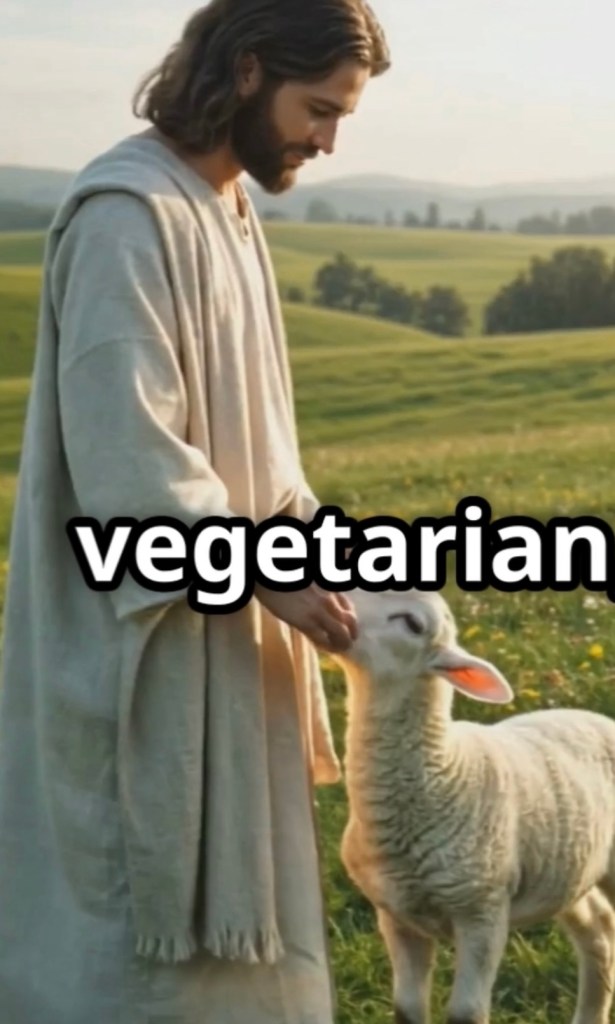
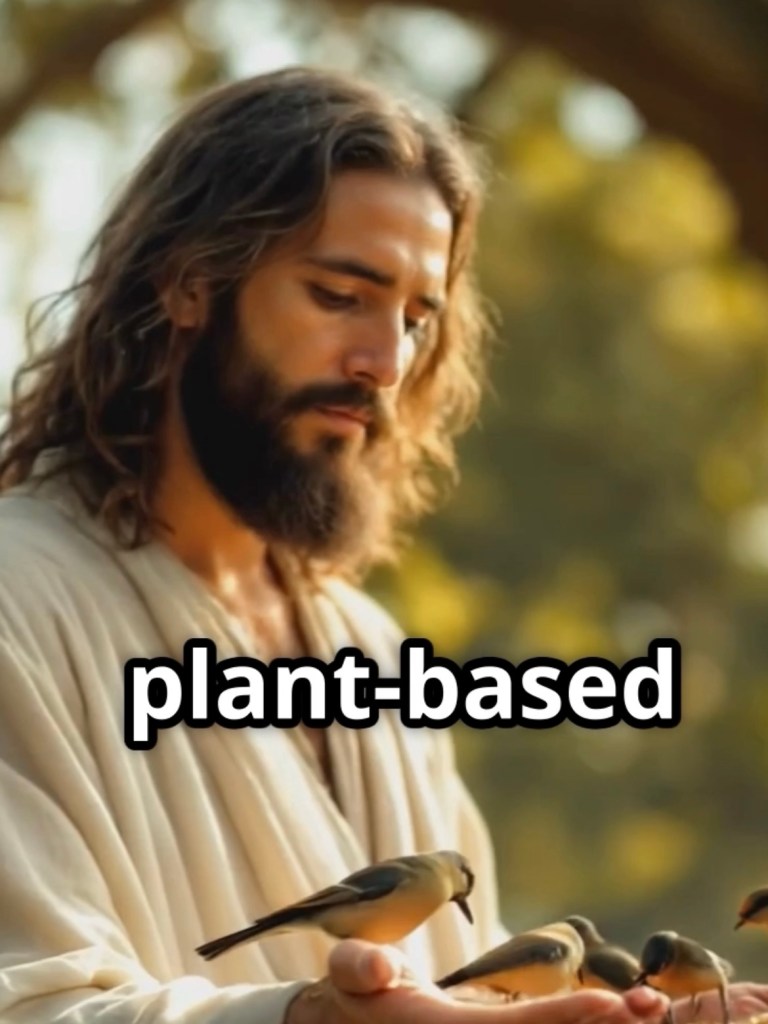
Was Jesus a Vegetarian? Exploring Scripture, Mistranslations, and His Compassion for Animals

For centuries, the image of Jesus as a compassionate healer and teacher has been at the heart of Christianity. But was he also an advocate for a plant-based lifestyle? Evidence from modern-day translations of the Bible, alternative gospel texts, and linguistic studies suggest that Jesus may have opposed eating animals and even challenged the way we interpret certain food references in scripture.

God’s Original Plan: A Plant-Based Diet

In the very beginning, God created a world where humans and animals lived in harmony, sustained by plant-based foods:

“Behold, I have given you every plant yielding seed that is on the face of all the earth, and every tree with seed in its fruit. You shall have them for food.”Genesis 1:29

This verse suggests that in God’s ideal world, food was meant to come from the earth, not from killing animals. Even the prophetic visions of Isaiah describe a future where animals live in peace and do not harm one another:

“The wolf and the lamb shall graze together… They shall not hurt or destroy in all my holy mountain, says the Lord.”Isaiah 65:25

If God’s vision for creation was one without bloodshed, could it be that Jesus, as the ultimate teacher of love and mercy, followed this principle?

Did “Fish” Get Mistranslated?

One of the strongest arguments against Jesus being vegetarian is his feeding of the multitudes with “loaves and fish” (Matthew 14:13-21). But what if the word fish was mistranslated?

• The Greek word Ichthys (ἰχθύς) not only means fish but was also a symbolic acronym for “Jesus Christ, Son of God, Savior”—suggesting that the references to fish might have had deeper meanings.

• In Aramaic, the language Jesus likely spoke, some plant-based foods such as seaweed, legumes, or even pressed figs could have been confused with “fish” in later translations.

• Many early Christian sects, including the Essenes, were vegetarian and believed that Jesus was as well.

This raises the question: if Jesus was compassionate toward all life, would he have condoned the killing of fish for food, or was this a later addition to align with changing cultural norms?

Jesus Sets the Animals Free in the Temple

One of the most powerful moments of Jesus’ ministry was when he overturned the tables in the temple and set the animals free:

“And He found in the temple those who were selling oxen and sheep and doves… and He poured out the coins of the money changers and overturned their tables.”John 2:14-16

Modern-day translations of the Bible often say Jesus condemned the merchants for turning the temple into a “den of thieves.” However, the original Hebrew word used in Jeremiah 7:11, which Jesus was quoting, actually means “violent ones” rather than “thieves.” This suggests his anger was not just about corruption but about the violence being inflicted on innocent animals in a place of worship.

Rather than allowing the continued sale and sacrifice of animals, Jesus set them free—a powerful statement that aligns with a plant-based, non-violent philosophy.

Daniel’s Vegetarian Diet and Spiritual Clarity

Daniel, a prophet highly respected in both Jewish and Christian traditions, refused to eat the king’s rich food (which likely included meat) and instead requested a plant-based diet:

“Test your servants for ten days; let us be given vegetables to eat and water to drink.”Daniel 1:12

After ten days, Daniel and his companions were healthier and wiser than those who ate the king’s food. This passage suggests that a plant-based diet was not only physically beneficial but also spiritually purifying.

Jesus’ Teachings Align with Compassion for All Beings

While modern-day translations of the Bible do not explicitly state that Jesus was vegetarian, many of his teachings align with the principles of nonviolence and mercy toward all living creatures.

• He taught that God cares even for the sparrows (Luke 12:6).

• He healed and showed kindness to animals (Matthew 12:11).

• He overturned the tables of those selling animals for sacrifice, condemning the violence done to them.

If Jesus preached love, mercy, and a return to God’s original vision for creation, wouldn’t this include sparing animals from suffering?

Conclusion: A Call to Rethink Tradition

Throughout history, translations and cultural shifts may have altered how we interpret Jesus’ relationship with food and animals. By examining scripture more closely, we find strong evidence that:

• God’s original plan was a plant-based diet.

• Key biblical words, like “fish,” may have been mistranslated.

• Jesus actively opposed animal sacrifice and set animals free.

• Vegetarianism was practiced by early followers like Daniel and the Essenes.

Whether or not Jesus was fully vegetarian, his message was clear: compassion, mercy, and peace should extend to all of God’s creation.

Could embracing a plant-based lifestyle today be a way to honor his teachings and return to God’s vision for a world without harm?

A Call for Compassion: The Case for Marie Antoinette

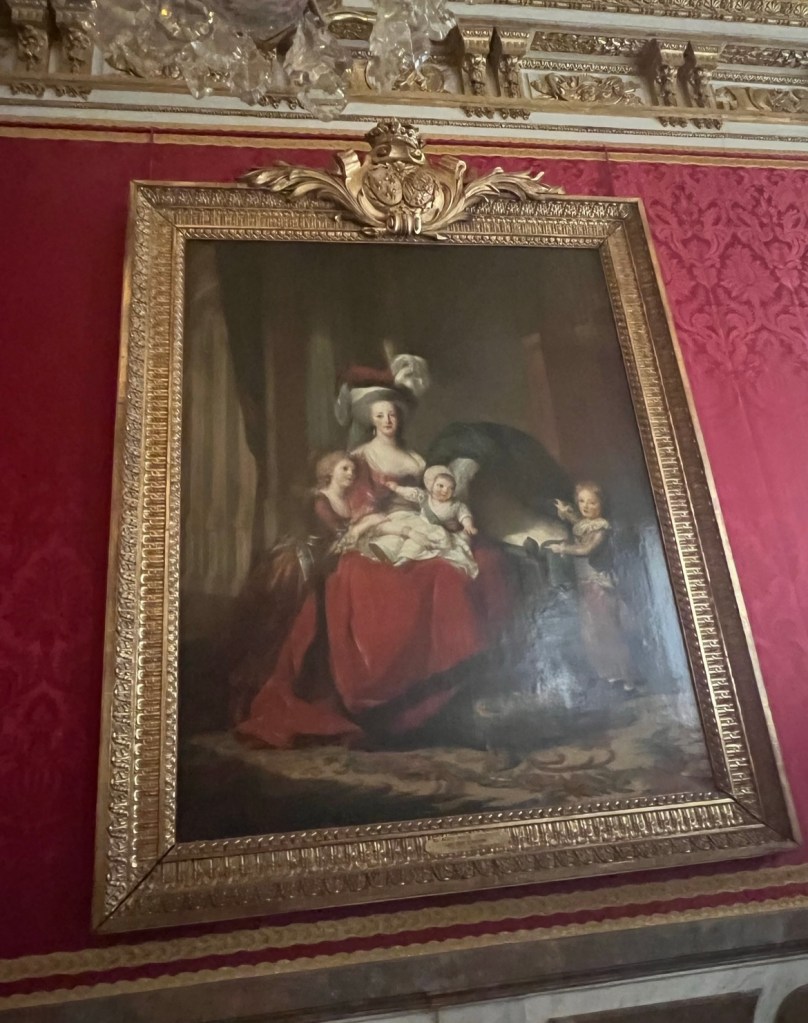
Marie Antoinette and her children in a portrait hanging in Versailles.

Revolution is in the air. Corruption is coming to light at a fast pace and the question of accountability is on everyone’s lips. Humanity has been through shifts like this before, and I think it’s important to reflect on how we’ve handled these shifts of consciousness for humanity in the past.

I discovered during 2023 that my family on my mom’s side, the French Rose line have lineage going back to Jean Jaques Rousseau in France. We were once Rousseau and changed the last name to Rose when we left France. Because of this, I paid special attention to his influence on France during my visits.

Jean Jacques statue at Chateau de Chenonceau in the Loire Valley.

Jean Jacques Rousseau’s philosophy writing the social contract and questioning the natural order of things spurred the dramatic shift in thought patterns of the French, ultimately leading them to revolution. He described the current state of affairs as artificial, a sort of Matrix like reality disconnecting us to the true peaceful order of things.

Unhappy with their lives under the Royals, and blaming individual people for their suffering, the French subjects had a true insurrection at Versailles, trashing the castle, and eventually killed the entire royal family, including the infamous Marie Antoinette. In many ways, I felt my ancestor’s influence lead to her death so I feel a sense of responsibility for it.

An « M » for Marie adorns her stairway.

Walking through Versailles, I got a true sense of who Marie Antoinette was as a person. As an empath I could feel her. I was also surprised to find Kirsten Dunst’s portrayal of her personality was fairly accurate according to both my tour guide and my inner knowing. She came from privilege and responsibility in Austria, and married a soon-to-be French king to solidify the relationship between the two countries. In many ways, her life was bound by the deeds of others and not of her own making.

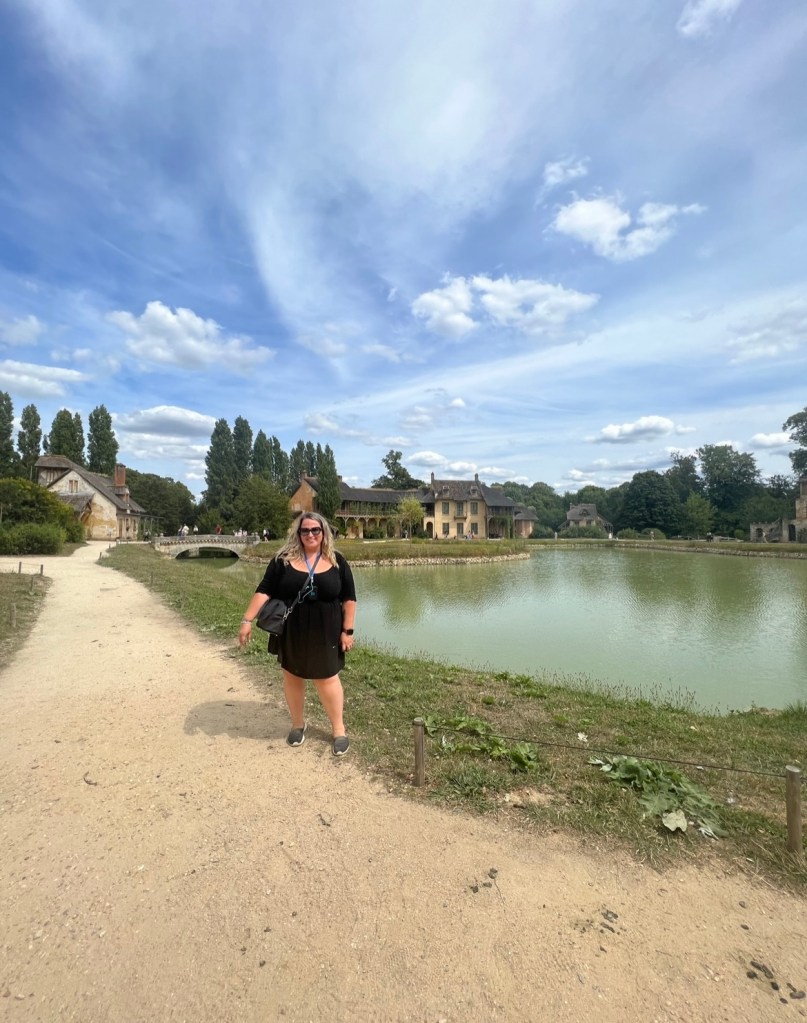
Walking the grounds of Le Hameau de la Reine July 2023.

It becomes abundantly clear that Marie tried to escape the demands of Versailles by building her country home, known as Le Hameau de la Reine, The Queen’s Hamlet. She lived and loved a simpler life in nature, growing food, baking sourdough, reading and meditating on the property. She felt the way her life was at Versailles was unnatural. She even had window coverings in her Hamlet, a true invention of pulleys and black out curtains not seen otherwise at her time. She yearned for a private life where she could just enjoy her days. Her decisions were meant to bring her own life peace in a difficult situation, but ultimately was perceived as uncaring and disconnected to the French people.

Marie was a fan of Rousseau, which is the ironic part of her demise. She is portrayed as reading a passage he had written while basking in the sun with her ladies outside at her Hamlet in the Sophia Coppola movie.

Kirsten Dunst as Marie Antoinette reading Rousseau, 2006.

“Rousseau says: If we assume man has been corrupted by an artificial civilization, what is the natural state? The state of nature from which he has been removed? Imagine wandering up and down the forest without industry, without speech, and without home.”

I see Marie as a gentle soul. A true lover of the natural world, which in many ways is what the French Revolution was all about.

To quote Marie’s cousin’s mother, the infamous Anne Boleyn who rose from commoner to queen, « To be a king and wear a crown is a thing more glorious to them that see it than it is pleasant to them that bear it. »

Marie’s cousin Elizabeth I quoted this passage by her mother in her famous « Golden Speech ».

This important sentiment shows the pressures the Royals were under and that it is a very different experience than those who perceive Royalty.

As we move yet again from subjects of the world governments into individual sovereignty, it’s important to see those who have demonstrated perceived crimes against humanity with compassion. Did they grow up in this matrix? Did they feel pressure to behave, act and think in a certain way? Is it possible someone is moving with the status quo out of concern of self preservation ? Like Marie Antoinette, the answer is yes, absolutely.

Unfortunately, she suffered gravely at the end. Her hair apparently turned white from fright as she approached her untimely death. The blood thirst of the French Revolution was unquenchable. They wanted the Royals to suffer like they felt they had suffered.

This is a call for compassion, a true case for the Marie Antoinette’s of today. They may be ready for change and yearning for a different life just like the rest of us. Violence begets violence. Is it possible to take the high road during revolution ? I think it’s time we try the Golden Rule even in the most extreme of circumstances. May the next revolution truly be a Golden one. ✨🫶

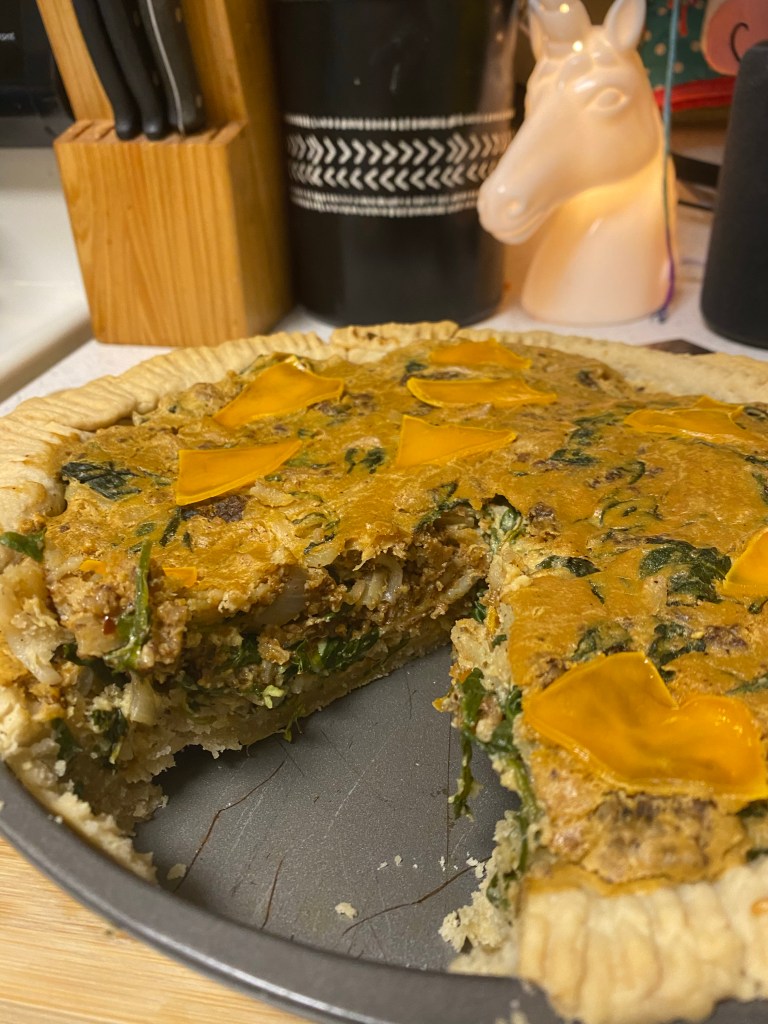
Vegan Breakfast Quiche

This vegan dish has the perfect flaky crust and savory flavors you’d expect from a breakfast quiche.

Crust ingredients:

⁃ 1 vegan egg (2 tbs of Follow Your Heart powder with 1/2 cup ice water, whisked)

⁃ 2 1/2 tablespoons ice water

⁃ 1 1/2 cups all-purpose flour

⁃ 1/2 teaspoon sea salt

⁃ 10 tablespoons vegan butter (I used Miyoko’s Oat Milk Butter)

Filling:

– 1 Yellow Onion, chopped into cubes

– 3 VeganEggs (6 level Tbsp Follow Your Heart VeganEgg whisked with 1 1/2 cups ice cold water)

– 1 cup homemade cashew cheese (cashews blended with nutritional yeast, veggie bouillon, veggie broth, garlic, and hot water)

– 1 tbsp vegan butter

– pinch red pepper flakes

– 1 tsp pepper

– 1/8 tsp cayenne pepper

– 1 cup of Hashbrowns (I used dehydrated shredded potatoes, salted to taste)

– 1 10 oz package fresh spinach

– Tbsp chopped fresh garlic

• Optional: vegan meat of your choice or vegan bac’n bits. (I personally used sautéed Chorizo bits from Nutcase Vegan Meats.) Top quiche with additional cheese if you like.

Directions:

Preheat oven to 400 degrees

Whisk salt and flour

Add vegan egg

Add butter

Knead until dough consistency.

Roll out on floured cutting board until it is the size of your pie pan.

Work dough into pie pan, pinching the ends to form a crust around the edge.

Finish with fork impressions on edge.

Freeze for 25 minutes.

Bake for 10 minutes at 400 degrees.

If crust bubbles up, pierce with fork.

Sautée onions until soft. Add hashbrowns with vegan butter until desired browning.

Pack the pan with spinach only allowing to remove excess water for one to two minutes tops.

Whisk vegan egg with additional water. Add garlic, onion, pepper, red pepper flakes, hashbrowns and spinach. Mix well.

Slightly stir in homemade vegan cheese and chorizo. I left clumps together and it turned out amazing.

Pour into crust.

Turn down oven to 325 degrees.

Cook for 55 minutes.

Voila! Enjoy!

For tips on making your own homemade cashew cheese, check out the full video on how it’s made.

Vegan Spanikopita

Compassion begins on your plate!! 💚🌱✨ Did you know most phyllo dough is vegan? I created a spinach feta mixture with 365 organic chopped spinach, garlic, onion, and Violife Foods Feta cheese and wrapped it up into little crispy triangles. 🤤🍃🌍💚 (Before I found Violife, I also used chèvre from Heidi Ho for that tangy, cheesy flavor you’d expect from a feta.) I am such a sucker for anything spinach and feta that I just had to veganize spanakopita that I missed so much! Give it a try😋!

You will need: (makes 12)

1 – 5 oz bag fresh organic spinach, chopped

1/4 cup olive oil

2 – blocks of Violife Feta Cheese, crumbled

1- clove garlic, chopped

1/2 – white onion, chopped

6 – sheets of Fillo Dough (I prefer to buy the Fillo Factory Organic Dough 16 oz box)

1- Melted stick of vegan butter (I prefer Earth Balance)

Directions:

(Pro tip: Dough must sit at room temp and thaw for two hours for easily malleable dough for folding.)

Preheat oven to 350 degrees.

Heat a tablespoon of oil in a skillet and add chopped garlic and onion. Sauté until onions slightly brown then add chopped spinach, stirring until wilts. Strain mixture, draining any extra liquid and let cool.

Crumble blocks of feta in separate bowl. Once the spinach mixture is cooled, mix with crumbled feta.

Warm stick of butter in pan.

Roll out phyllo dough sheet on cookie sheet or cutting board. Cut down the middle. Brush melted butter on top. Place heaping spoonful of spinach feta mixture at bottom of one side of the halved sheet. Fold over the phyllo dough, flag-style rotating each fold to become a triangle. Brush top of filled triangle with butter again.

Repeat until spinach feta mixture is empty.

Place triangles evenly on cookie sheets and bake for 25-30 minutes or until the dough is flaky, and browning at edges.

Let triangles cool for 5 minutes, and enjoy!!

Is Pizza Hut Bought by the US Dairy Industry?

Can you hear the collective sigh of disappointment today? Despite an outpouring of positive press, Pizza Hut rescinded the announcement of vegan cheese finally coming to their United States locations this summer.

This, sadly, did not surprise me. I was more surprised to find out they were doing the right thing after all these years.

Why? There’s a trend! My brain sees connections, and apparently I am not alone.

Both Domino’s and Pizza Hut have a lot in common financially. They both opened vegan markets successfully in other countries, yet they do not bring these options to the US despite knowing it works.

This is puzzling, because they have undoubtedly lost customers refusing to evolve with consumer demand for dairy free options. Me included! Your girl was a regular at the Rochester Hills Pizza Hut in high school, and the delivery guy knew me well when I was a vegetarian ordering stuffed crust pizza (I now shudder to think of all the baby cows killed for the amount of cheese I consumed). Shifting to a dairy free, plant based diet meant buying vegan pizza elsewhere. And there are tons of yummy options at locally owned establishments.

If United States consumer groups are demanding vegan cheese, yet the restaurant does not cater to consumer demand, why would they make a decision to not carry vegan options from a financial standpoint? Wouldn’t the market research show that vegan cheese is not only the right thing to do for the animals, but actually, dare I say, profitable?

Unfortunately, it’s much bigger than that.

The dairy industry proudly boasts about their financial partnerships with both Pizza Hut and Domino’s. Both companies not only take money from the dairy industry, but they use the Dairy industry scientists and nutritionists to introduce more menu items to push larger amounts of milk.

According to Dairy.org on a February 2018 release, “Pizza Hut – a dairy checkoff partner- increased the amount of cheese on its pan pizzas by 25 percent, a move that will require an additional 150 million pounds of milk annually to meet the change.”

They go on to say that the “project was made possible thanks to dairy scientist Nitin Joshi, a Dairy Management Inc. (DMI) employee who works onsite at Pizza Hut’s headquarters in Plano, Texas.“

Read that again. Let it really sink in.

The Dairy Industry not only gives money to certain big chain restaurants, but they actually have employees on site developing more products that push 150 million gallons more of milk per year. Products are designed for the sole purpose of pushing an agenda for US Dairy Farmers, and that agenda is far from human health.

Following the money further, we look at Domino’s, and their financial partnership with the US dairy industry.

According to a 2018 press release from Dairy.org, because of their partnership, Domino’s “increased their cheese usage by over 1 BILLION milk equivalent pounds. That’s just shy of 20,000 tanker loads of milk that was off the market because of the Domino’s partnership.”

They aren’t selling billions more in pizzas. They are updating their menu items to use more cheese to push more milk. Once upon a time, you could order Domino’s Breadsticks and they didn’t come with melted cheese. Now, you can’t even get their breadsticks without melted cheese, and they are a completely different product.

They go on to say at Dairy.org, “in addition to menu development, Domino’s has also been a partner in sharing the story of dairy farmers through the Undeniably Dairy campaign.  Last summer, Domino’s put the Undeniably Dairy logo on their pizza boxes across the country – reaching 7 million homes a week.”

As a business school grad that studied marketing, let’s really look at what is being done here.

Not only are they working hand-in-hand with the dairy industry to develop menu items pushing higher percentages of cheese usage on products (which is keeping America sick, but that’s another discussion for another day), they are also using marketing through their materials they use to distribute their products to psychologically get you to feel some allegiance to the “Hardworking US Dairy Farmer”. They even have language on their box boasting pizza isn’t pizza without tons of cheese. “How can it be anything else?” says the Domino’s box regarding dairy cheese.

Now, as someone who has eaten actual Italian pizza in Naples, Italy, pizza traditionally highlighted tomatoes and sauce more than copious amounts of cheese. And it’s delicious. It’s the agenda behind the marketing to make you believe you need the cheese to have a good pizza, and they are going so far to push that you should feel good about it because you are keeping people employed. Cheese is super addictive in nature, as milk was meant to encourage baby cows to latch on to their mothers, so it’s easy to give in to this message for the average consumer.

Meanwhile, billions of animals are being slaughtered, and many consumers are opting for the nut milks versus the cows milk. So doesn’t voting with our dollars help?

The Dairy Farmers of America (DFA) recently released a statement that traditional milk sales plummeted by $1.1 billion in 2018, so where is all of this dairy money coming from now that consumers are voting with their dollars?

The answer is the United States Government.

According to an ABC news article in August 2018, the USDA stepped in to buy 50 million in surplus milk to bail out the dairy industry. Where does all this milk go?

According to the article, “The USDA is buying the milk under a program that allows the government to buy surplus food or agricultural products and redirect them to food banks or school-nutrition programs.”

So even when we are voting with our dollars that we do not want to consume milk, they repurpose the surplus to encourage milk consumption by our children in schools.

Isn’t the government supposed to reflect what it’s citizens want?

Let’s not even get into the money circulating between the government and the dairy industry. I encourage you all to watch What The Health on Netflix or YouTube. The doc really lays out all of the financial connections between restaurants, the medical community, the dairy industry, and the government. The Thrive Movement documentary will take it a step further for you to show you who really pulls those strings. (Spoiler Alert: it’s not Trump.)

The day the US government decides to stop bailing out the dairy industry is the day the dairy industry will stop having the ability to lobby and push more dairy, even though demand of milk is technically down. That’s the only presumable reason there’s a resistance of adding vegan cheese at some quick food establishments — it won’t be until they realize their profits can be gained back by the consumers when they do finally lose that US Dairy money. And the day is coming. 😘

There is so much more than our dietary preferences at stake. In many ways, our preferences are being taught at an early age to support corrupt industries.

To keep someone in the dark means to keep someone from being informed. I hope posting this information sheds some light that leads to major changes. We totally have the power to manifest our higher desires, Peace and Prosperity on Earth, and while it seems overwhelming when looking at Earth’s dark parts, we can’t fix what we don’t know about. ✌🏼💚🌱✨

Links to Sources:

Dairy Industry and Domino’s Undeniably Strong Partnership

ABC News: US Government Buys 50 Million in Milk to Bail Out Dairy Farmers

PizzaHut Dairy Partership Leads to 25% More Cheese

Fast Company: Milk Sales Plummeted by 1.1 Billion Last Year

Documentaries Mentioned:

What the Health

The Thrive Movement

Excerpt Clip from Thrive Movement “Follow the Money”: