

I read The Gospel of the Holy Twelve front to back after having a spiritual moment in France that made me question the origins of Christianity. I couldn’t put it down. It resonated with the Holy Spirit that dwells within me, deeper than any sermon or scripture I had encountered growing up. I was raised a vegetarian Catholic, yet I never knew there were early Christian teachings that not only supported this lifestyle but embodied it. I had never been told that reincarnation was plausible… or that a vegetarian Jesus was very likely. These truths had been hidden… but once I saw them, I couldn’t unsee them.
For centuries, Christianity has been presented through the lens of empire, tradition, and convenience. But what if the original teachings of Jesus were far more radical… far more compassionate… than we’ve been led to believe? What if Christianity, at its very roots, was a vegan movement?
That’s the bold yet spiritually grounded claim made in The Gospel of the Holy Twelve, a recovered text translated by Reverend Gideon Jasper Ouseley in the late 19th century. Ouseley claimed he had access to ancient Aramaic manuscripts preserved by a secret brotherhood, which offered a truer, unedited version of Jesus’ life and message. While the origins of the manuscript remain controversial, the gospel’s teachings align strikingly with what we know of early Jewish-Christian sects, particularly the Ebionites and the Essenes (Eisenman, James the Brother of Jesus, 1997).

In this gospel, Jesus stands not only as a healer and teacher but as an advocate for all sentient life. He does not bless the slaughter of animals… he condemns it. He does not multiply fish… he frees them. And he declares, “They who partake of benefits which are gotten by wronging one of God’s creatures, cannot be righteous: nor can they touch holy things, or teach the mysteries of the kingdom.” (Ouseley, The Gospel of the Holy Twelve, Lection XLVI)
Rooted in Early Tradition
Though The Gospel of the Holy Twelve is not part of the modern biblical canon, its tone and teachings are not without historical merit. Ouseley and others believed it to reflect the original Hebrew Gospel referenced by early Church Fathers like Jerome, who wrote of a “Gospel of the Hebrews” used by Jewish-Christian groups (Jerome, De Viris Illustribus, 3).
These groups, including the Ebionites and the Nazarenes, believed Jesus came not to abolish Jewish law but to fulfill it through love and nonviolence (Eusebius, Ecclesiastical History, Book III). They rejected blood sacrifice, practiced vegetarianism, and upheld a mystical form of Judaism centered around compassion and purity. The Church Father Epiphanius, though critical, confirmed the Ebionites’ vegetarianism and rejection of temple sacrifice (Panarion, 30.15.3).
The broader context of these communities was later supported by discoveries like the Dead Sea Scrolls. Found between 1947 and 1956 near Qumran, the scrolls revealed a rich diversity of Jewish sects in the Second Temple period, many of whom—especially the Essenes—emphasized spiritual law, nonviolence, ritual purity, and apocalyptic expectations. Scholars such as Geza Vermes and Elaine Pagels have argued that the scrolls lend credibility to the existence of early traditions outside the later Christian orthodoxy (Vermes, The Complete Dead Sea Scrolls in English, 2004; Pagels, The Gnostic Gospels, 1979).
When Empire Meets Religion
The Jesus portrayed in The Gospel of the Holy Twelve is far removed from the sanitized, empire-friendly figure canonized under Constantine. By the fourth century, Christianity was institutionalized under the Roman Empire. With the Council of Nicaea (325 AD) and subsequent imperial sponsorship, the faith became increasingly aligned with hierarchy, sacrifice, and patriarchy.
This shift has been documented by historians such as Bart Ehrman and Karen Armstrong, who show how early diversity in Christian theology was gradually suppressed as the church merged with imperial power (Ehrman, Lost Christianities, 2003; Armstrong, The Battle for God, 2000). The radical, liberating message of the original Jesus movement—rooted in inner transformation and justice for the marginalized—was traded for control, conformity, and obedience.
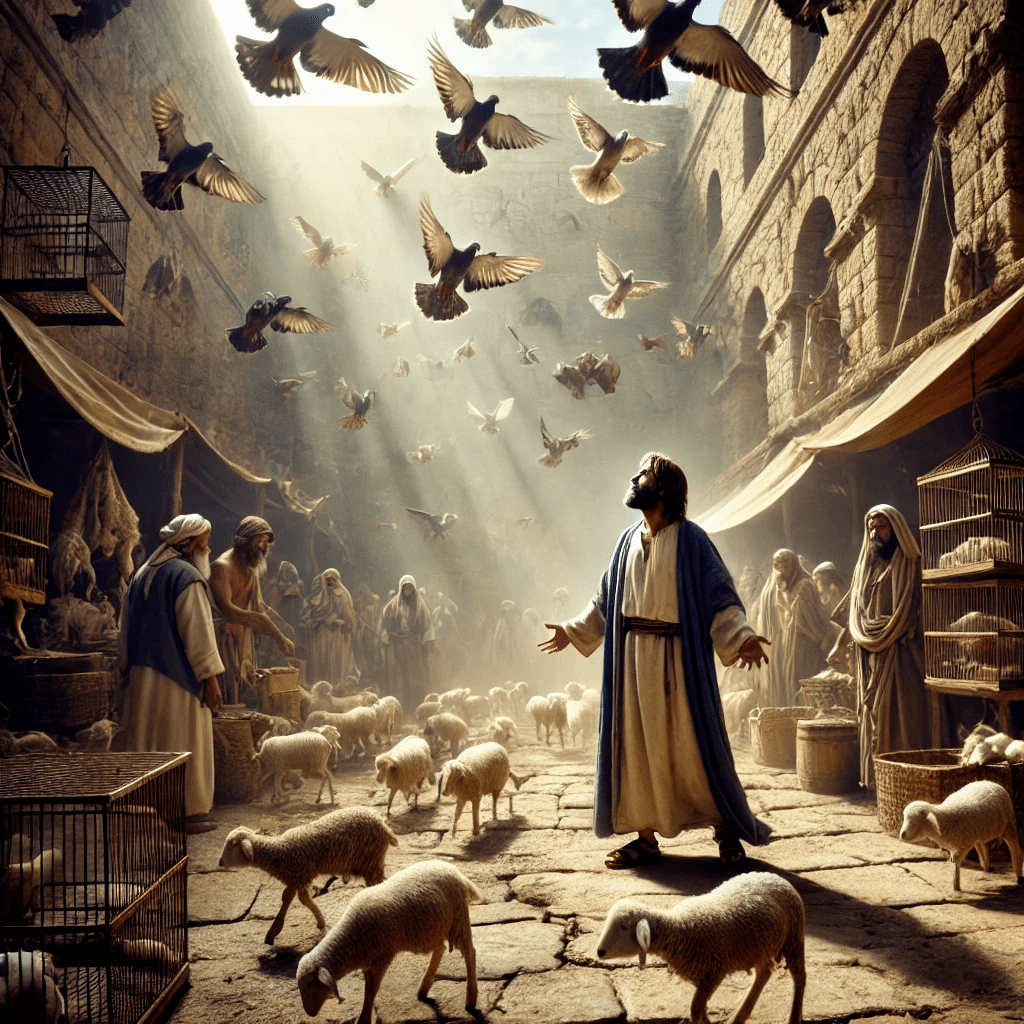
The teachings found in The Gospel of the Holy Twelve directly challenge this evolution. In one passage, Jesus drives the animal sellers from the temple—not merely for commercializing religion, but for desecrating life itself. “Ye have made the House of Prayer a den of thieves, and filled it with cruelty and blood,” he says (Ouseley, Lection XXXIV). Notably, the word “thieves” in the original Hebrew could also be rendered as “violent ones” (Strong’s Concordance, H2555 – chamas), reinforcing this interpretation.
A Logos of Compassion
In the text, Jesus speaks of the “Holy Law” written not on scrolls, but in the heart—echoing the Jewish prophetic tradition (Jeremiah 31:33). He embodies the Logos not as doctrine, but as a way of life grounded in reverence for all creation. This connects not only to early Jewish mysticism, but to figures like St. Francis of Assisi, who called animals his brothers and sisters, and rejected worldly power in favor of divine simplicity.
Indeed, The Gospel of the Holy Twelve suggests that spiritual awakening is inseparable from ethical living. This idea, though controversial to institutional religion, resonates with mystical traditions across faiths—including Kabbalah, Sufism, and Eastern philosophies, all of which honor the sacred interdependence of life.
A Christianity Worth Returning To
What would Christianity look like if we re-centered it around this compassionate Christ? Around a Jesus who called for mercy, not sacrifice (Hosea 6:6, quoted by Jesus in Matthew 9:13)… who broke chains, not breaded fish… who lived in harmony with creation rather than domination over it?
Many are beginning to ask this question—not out of rebellion, but out of a deep spiritual longing to reclaim what was lost.
We may never fully prove the historical origin of The Gospel of the Holy Twelve. But history alone doesn’t determine truth. As Jesus said, “Ye shall know them by their fruits” (Matthew 7:16). And if truth bears good fruit—if it leads to greater compassion, justice, and unity—then the gospel’s message is one worth listening to.
Whether we call it the Holy Spirit, the voice of conscience, or divine wisdom… something is guiding many of us back to this lost path. And perhaps that’s not a coincidence—but a resurrection of something long buried.
Knowing what we now know about early Christianity, if Jesus were here—reincarnated, as some traditions suggest, with his radical compassion intact—would modern Christianity even recognize Him?


 Julie Tourangeau