
By Julie Tourangeau | julietour.com
This reflection connects to Chapter 2 of The Lost Path to Freedom
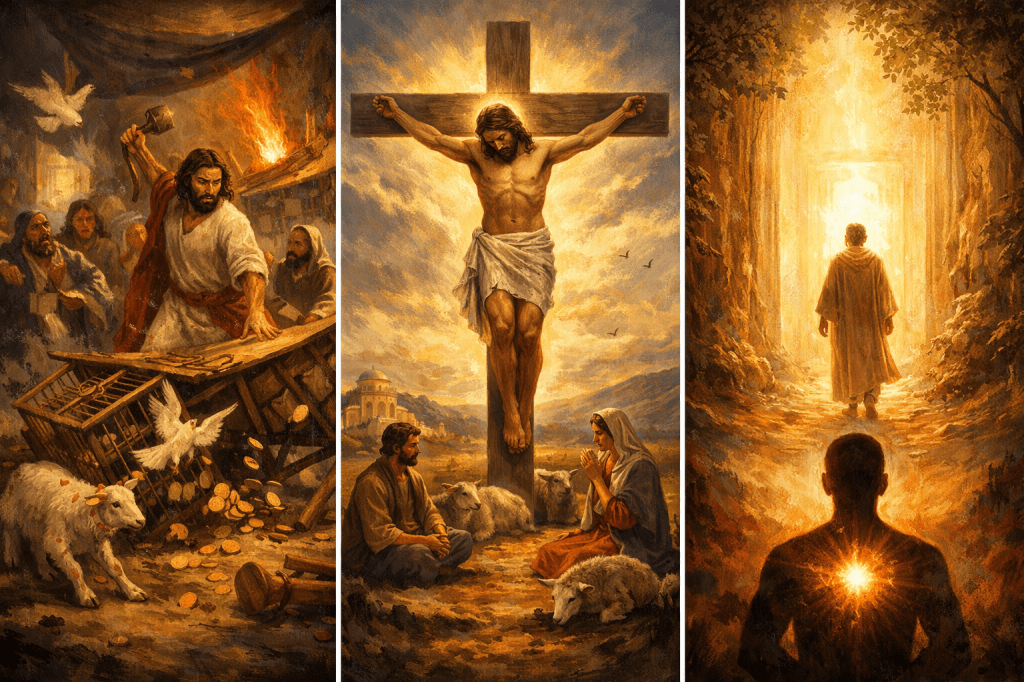
Good Friday, as told in modern-day translations of the Bible, is often framed as a necessary sacrifice: Jesus dying for humanity to satisfy a divine requirement.
But what if that framing itself is the misunderstanding?
What if Jesus was not the fulfillment of sacrifice…
but the one who came to end it?
⸻
The World He Walked Into
In the time of Jesus, sacrifice was not symbolic—it was literal.
Animals were bought, sold, and slaughtered in the Temple as offerings to God. It was a system intertwined with religion, economics, and power. Priestly authority depended on it. Rome tolerated it.
It was normalized.
And into that world stepped Jesus—not as a participant, but as a disruptor.
⸻
“I Desire Mercy, Not Sacrifice”
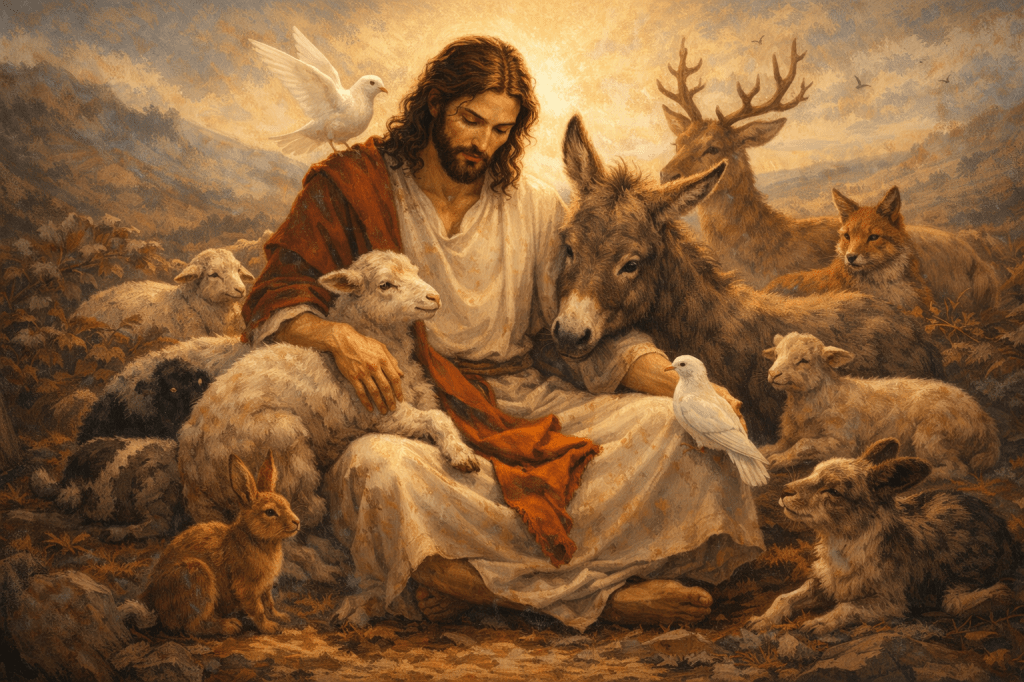
In The Gospel of the Holy Twelve, Jesus is portrayed as one who rejected blood sacrifice entirely. He teaches reverence for all living beings and calls for a return to a purer, nonviolent expression of faith.
His message is clear:
God does not require death to be pleased.
God desires mercy.
This wasn’t just spiritual—it was revolutionary.
Because if sacrifice is no longer needed…
then the entire religious power structure begins to collapse.
⸻
The Temple Was Not What It Seemed
One of the most misunderstood moments in the life of Jesus is his cleansing of the Temple.
He overturns tables. Drives out those selling animals. Interrupts commerce.
This wasn’t random anger.
It was targeted.
A direct confrontation with a system built on the suffering of innocent life—justified in the name of God.
From this lens, it wasn’t simply about “money changers.”
It was about ending the cycle of sacrifice.
And that made him dangerous.
⸻
Why He Had to Be Silenced
When we ask, Why was Jesus killed?—we’re often told it was political, or that it fulfilled prophecy.
But from this perspective, the answer becomes clearer:
He threatened both religious authority and economic control.
• If people no longer believed in sacrifice, the Temple system lost its power.
• If God was found within, intermediaries were no longer needed.
• If compassion replaced ritual, control began to dissolve.
Jesus didn’t just challenge behavior.
He challenged the entire framework.
And systems built on power rarely surrender quietly.
⸻
The Inner Revolution
In The Gospel of Thomas, there is no emphasis on sacrifice—only awakening.
Jesus says:
“Whoever discovers the interpretation of these sayings will not taste death.”
This is not about physical survival.
It is about transformation.
The “death” is ignorance.
The “resurrection” is awareness.
And in that awareness, the need for sacrifice disappears—because separation disappears.
You no longer need to offer something to God…
when you realize you were never separate to begin with.
⸻
The Final Irony
The greatest irony of Good Friday may be this:
The one who came to end sacrifice…
was turned into one.
His death was later framed as the ultimate offering—a narrative that, in many ways, reintroduced the very system he sought to dissolve.
But if we look deeper, we can see through it.
The cross was not an altar.
It was a consequence.
A consequence of speaking truth in a world not ready to hear it.
⸻
A Different Kind of Salvation
From this perspective, salvation is not about believing in a sacrifice.
It is about awakening from it.
It is about remembering:
• That God does not require blood—only love.
• That no life is meant to be taken in the name of the divine.
• That the Kingdom Jesus spoke of was never built on suffering—but on compassion.
⸻
The Invitation of Good Friday
Good Friday is not just a story of death.
It is a moment that asks:
What systems are still being upheld in the name of God…
that contradict love?
What sacrifices are still being justified…
that were never truly required?
And what would happen…
if we finally let them go?
Because maybe the real resurrection begins the moment we do.
 Julie Tourangeau