Good Friday through the Lens of Early Christianity: The Cross, the Silence, and the End of Sacrifice

By Julie Tourangeau | julietour.com

This reflection connects to Chapter 2 of The Lost Path to Freedom
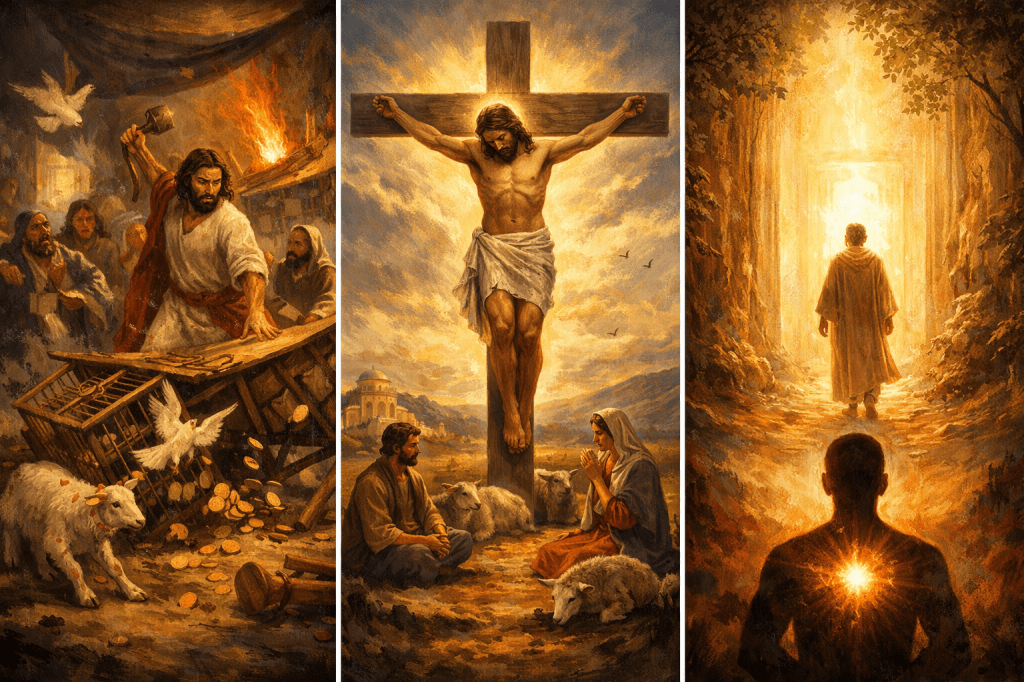
Good Friday, as told in modern-day translations of the Bible, is often framed as a necessary sacrifice: Jesus dying for humanity to satisfy a divine requirement.

But what if that framing itself is the misunderstanding?

What if Jesus was not the fulfillment of sacrifice…

but the one who came to end it?

The World He Walked Into

In the time of Jesus, sacrifice was not symbolic—it was literal.

Animals were bought, sold, and slaughtered in the Temple as offerings to God. It was a system intertwined with religion, economics, and power. Priestly authority depended on it. Rome tolerated it.

It was normalized.

And into that world stepped Jesus—not as a participant, but as a disruptor.

“I Desire Mercy, Not Sacrifice”

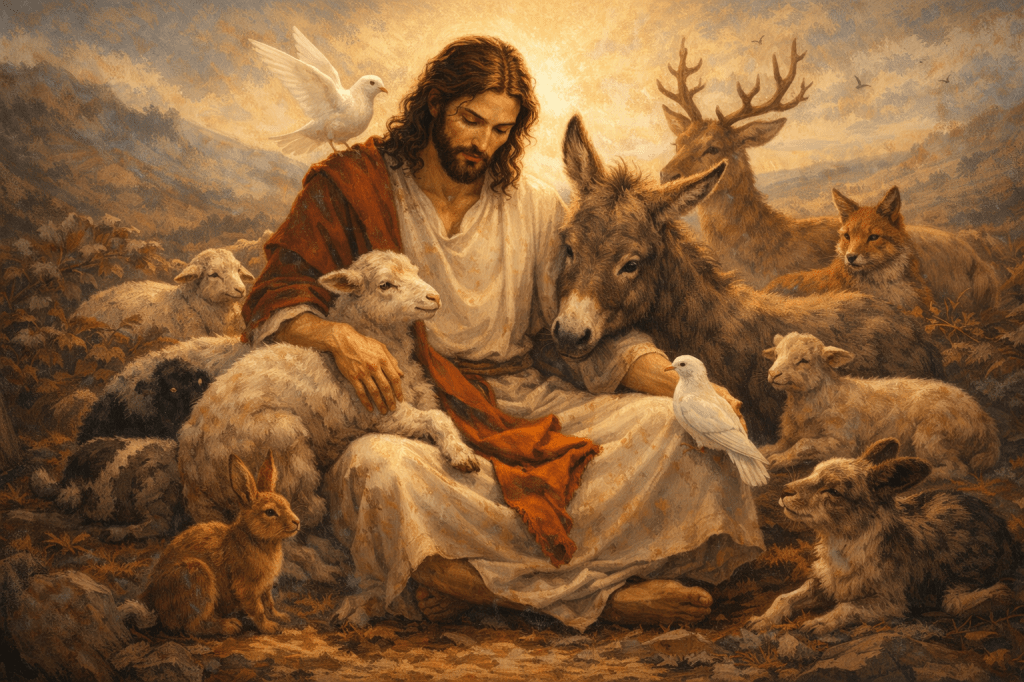
In The Gospel of the Holy Twelve, Jesus is portrayed as one who rejected blood sacrifice entirely. He teaches reverence for all living beings and calls for a return to a purer, nonviolent expression of faith.

His message is clear:

God does not require death to be pleased.

God desires mercy.

This wasn’t just spiritual—it was revolutionary.

Because if sacrifice is no longer needed…

then the entire religious power structure begins to collapse.

The Temple Was Not What It Seemed

One of the most misunderstood moments in the life of Jesus is his cleansing of the Temple.

He overturns tables. Drives out those selling animals. Interrupts commerce.

This wasn’t random anger.

It was targeted.

A direct confrontation with a system built on the suffering of innocent life—justified in the name of God.

From this lens, it wasn’t simply about “money changers.”

It was about ending the cycle of sacrifice.

And that made him dangerous.

Why He Had to Be Silenced

When we ask, Why was Jesus killed?—we’re often told it was political, or that it fulfilled prophecy.

But from this perspective, the answer becomes clearer:

He threatened both religious authority and economic control.

• If people no longer believed in sacrifice, the Temple system lost its power.

• If God was found within, intermediaries were no longer needed.

• If compassion replaced ritual, control began to dissolve.

Jesus didn’t just challenge behavior.

He challenged the entire framework.

And systems built on power rarely surrender quietly.

The Inner Revolution

In The Gospel of Thomas, there is no emphasis on sacrifice—only awakening.

Jesus says:

“Whoever discovers the interpretation of these sayings will not taste death.”

This is not about physical survival.

It is about transformation.

The “death” is ignorance.

The “resurrection” is awareness.

And in that awareness, the need for sacrifice disappears—because separation disappears.

You no longer need to offer something to God…

when you realize you were never separate to begin with.

The Final Irony

The greatest irony of Good Friday may be this:

The one who came to end sacrifice…

was turned into one.

His death was later framed as the ultimate offering—a narrative that, in many ways, reintroduced the very system he sought to dissolve.

But if we look deeper, we can see through it.

The cross was not an altar.

It was a consequence.

A consequence of speaking truth in a world not ready to hear it.

A Different Kind of Salvation

From this perspective, salvation is not about believing in a sacrifice.

It is about awakening from it.

It is about remembering:

• That God does not require blood—only love.

• That no life is meant to be taken in the name of the divine.

• That the Kingdom Jesus spoke of was never built on suffering—but on compassion.

The Invitation of Good Friday

Good Friday is not just a story of death.

It is a moment that asks:

What systems are still being upheld in the name of God…

that contradict love?

What sacrifices are still being justified…

that were never truly required?

And what would happen…

if we finally let them go?

Because maybe the real resurrection begins the moment we do.
Did We Get Jesus’ Name Wrong? The Mystical Link Between “Jesus” and “Je Suis”

What if the name we’ve used for two thousand years was never meant to be a name at all—but a reminder? And when did Yeshua became known as Jesus?

What if the true teaching of Jesus wasn’t about worshiping a man, but awakening to a presence? And what if this presence was so powerful, so sacred, that its very utterance—I AM—was the key to divine union?

This idea isn’t as far-fetched as it may sound. In fact, threads from early Christian texts, Gnostic wisdom, and even Southern French oral traditions suggest we may have misunderstood not only the teachings of Jesus—but his name itself.

The “I AM” That Jesus Taught

Throughout the Gospel of John, Jesus speaks in powerful first-person declarations:

• “I AM the light of the world.”

• “I AM the good shepherd.”

• “I AM the resurrection and the life.”

• “Before Abraham was, I AM.”

To modern ears, these might sound like poetic metaphors. But to those familiar with the Hebrew scriptures, they echo something far deeper.

In Exodus 3:14, when Moses asks the divine name, God replies: Ehyeh Asher Ehyeh—“I AM that I AM.” This was not a title or concept, but a declaration of being. A presence.

When Jesus uses the same phrase in Greek—ego eimi—he’s not just identifying himself. He’s inviting us into a state of awareness: that the divine lives in us, and through conscious presence, we too can say “I AM.”

Gnostic Echoes: Know Thyself, Know the Divine

The Gospel of Thomas, a text excluded from the Bible but revered by early mystics, records Jesus as saying:

“The Kingdom is inside you and outside you. When you know yourselves, you will be known, and you will realize that you are children of the living Father.”

Here again, we see the theme: inner knowing as the path to divine realization. Not belief in dogma. Not rituals of worship. But direct, conscious presence.

This aligns strikingly with the teachings of mystics across traditions—from the Kabbalistic “Ain Sof” to Eckhart Tolle’s modern insights on “the power of now.”

But could this message have traveled further than we thought?

When “Je Suis” Became “Jesus”

In Southern France, legends tell of Mary Magdalene traveling to Provence after the crucifixion, continuing the teachings of inner freedom, divine presence, and spiritual liberation. Centuries later, groups like the Cathars echoed these same values—rejecting church hierarchy, embracing nonviolence, and teaching direct access to the divine.

And here’s where it gets interesting.

In French, je suis means “I am.” And the spelling is very close to « Jesus ».

Could it be that early mystics—whether in oral tradition, meditation, or chant—were repeating the phrase “je suis” to declare their divine identity?

Could they have said, “Je suis the way, the truth, and the life”—and over time, this mystical mantra became mistaken for a name?

Could “Jesus” have evolved not from misunderstanding Aramaic, but from mishearing Presence?

It’s speculative, yes. But also poetic. Because whether or not the name “Jesus” comes from “Je suis,” the teaching remains:

Christ is not a name. It’s a state of being.

A consciousness of love, unity, and sacred presence.

Returning to the Forgotten Path

Maybe we didn’t get the name “wrong” so much as we got the emphasis wrong.

Instead of fixating on the figure, we were meant to awaken to the frequency.

Instead of worshiping “Jesus,” we were meant to embody je suis.

“I AM the light of the world” was never a boast. It was a mirror.

It was a call to remember who we really are.

And whether or not the evolution from je suis to Jesus is historically provable, the synchronicity is striking. A divine wink, perhaps—reminding us that even language carries echoes of forgotten truth. The path to presence has always been there, hidden in plain sight, waiting for those with ears to hear.

So today, in a world awakening from spiritual amnesia, maybe we’re ready to hear the original message again.

Not as a name.

But as a truth.

Je suis.

I AM.