
Den of “Thieves”? Or Something Deeper.

By Julie Tourangeau | @julietour

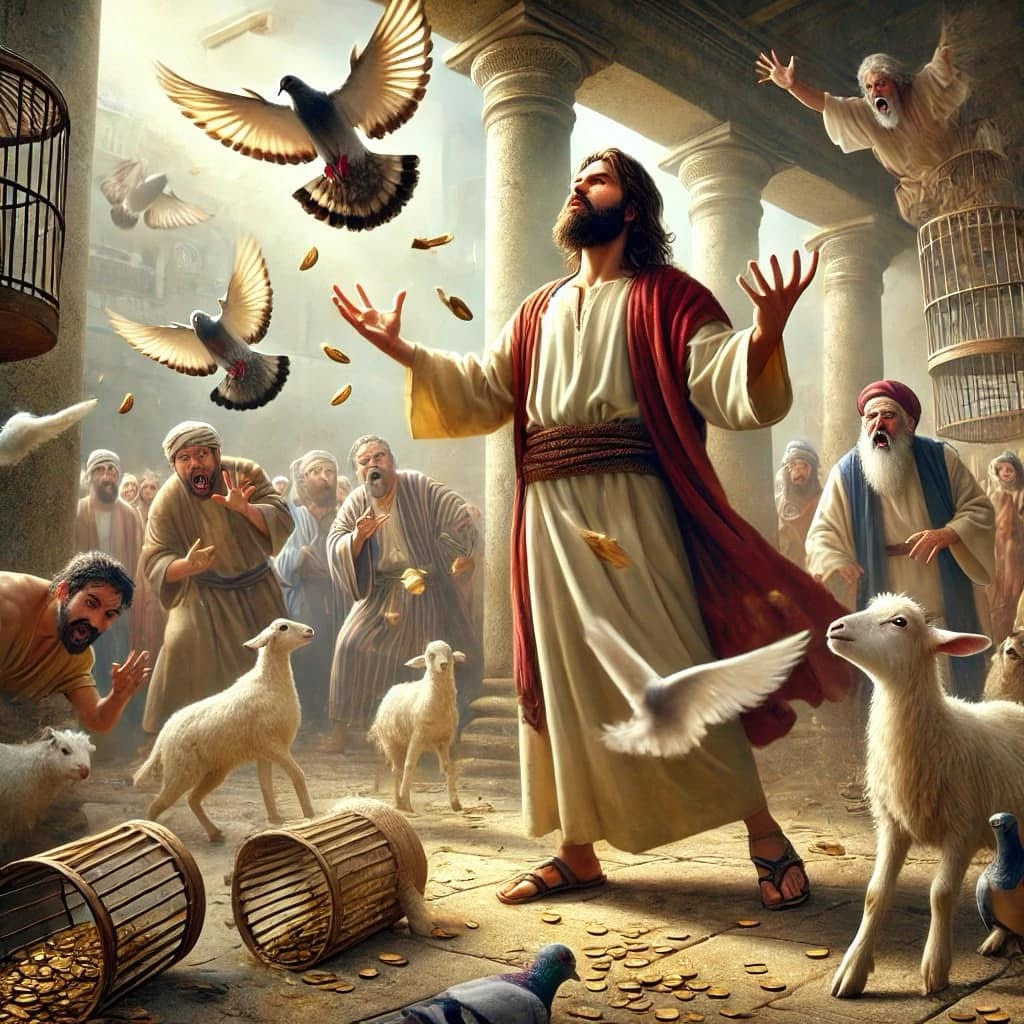
When Jesus stormed the temple courts, overturning tables and driving out the money changers, we’re often told it was a righteous act against corruption—against the “thieves” who turned a holy place into a marketplace.

But what if that’s only part of the story?

What if the word “thieves” doesn’t quite capture what was happening?

The Word We Missed

The original Hebrew word used in this passage is “perits” (פָּרִיץ)—often translated as “thieves,” but more accurately meaning violent ones, marauders, or destroyers.

This isn’t about petty crime.

It’s about violence.

About those who had turned the temple—a place meant for prayer, reverence, and peace—into a place of bloodshed.

Jesus wasn’t just flipping tables over coins.

He was confronting the violent ritual slaughter of animals in the name of God.

His protest wasn’t just about dishonest trade.

It was a cry for compassion, for justice, for a return to the sacred.

If He Walked Among Us Now

If Jesus were alive today—reincarnated, awake to the fullness of his early teachings—what would he see?

Would he walk into modern-day churches and find doves for sale?

Would he find lambs being sacrificed?

No.

But he’d find the same violence, cloaked in different robes.

He’d see his name invoked over meals made of suffering.

He’d see Easter tables lined with lambs, celebrated in remembrance of his own crucifixion.

And I imagine he’d grieve.

I imagine he’d say:

“You claim to follow me, yet you partake in the very acts I condemned.

You remember my suffering with the suffering of the innocent.

You turn my table of liberation into an altar of slaughter.

Have you not learned?”

The Lost Path

Early Christians understood dominion as stewardship, not superiority.

They practiced mercy, not sacrifice.

They aligned themselves with the Lamb of God, not the priests of Empire.

But somewhere along the way, that path was lost.

Love was replaced by law.

Awakening was replaced by ritual.

And the animals—the innocent ones Jesus likely defended—were left behind.

It’s Time to Return

The temple was never meant to be a place of blood.

The gospel was never meant to justify harm.

And Jesus never died so we could keep killing in his name.

He flipped tables to wake people up.

And maybe, just maybe…

he’s still doing it.

Let those with ears hear.

Let those with hearts soften.

Let us return to the path of compassion—for all beings.

The Vision That Changed Everything: How Paul’s Rise Silenced James—and Compassion

James, Jesus, Paul

By Julie Tourangeau | @julietour

Excerpted from the upcoming book: The Lost Path to Freedom

What if Paul wasn’t just on his way to persecute random followers of Jesus—but was headed straight for James the Just, Jesus’ own brother, when everything changed?

We’ve all heard the story—Paul (back when he was Saul) was hunting down early Christians when he had that dramatic vision on the road to Damascus. A blinding light, a voice from heaven, and just like that, the greatest apostle was born.

That’s what we’re told. But something about it always felt… off.

Because who was Paul really after?

The people following Jesus back then weren’t part of a new religion. They were Jewish. They were still in Jerusalem. And they were led not by Paul—but by James the Just, a man known for his deep humility, nonviolence, and devotion to the Torah.

James didn’t eat meat or drink wine. He was gentle, righteous, and beloved by all. His lifestyle was a continuation of everything Jesus lived and taught.

And if Paul was headed to Damascus to stamp out this movement—there’s a very real chance that James was on his list.

But then Paul claims he saw a vision of Jesus. Everything changed.

Or… did it?

A Vision—or a Convenient Redirection?

After that vision, Paul didn’t seek out James. He didn’t go to Jerusalem to learn from the people who actually walked with Jesus. In fact, he makes a point to say he didn’t.

According to his own words in Galatians, he kept his distance from the original apostles. Instead, he started preaching his own version of the gospel—one he says came directly from revelation, not from “any man.”

And that version? It contradicted a lot of what Jesus and James were actually doing.

• James taught that faith without action is meaningless. Paul said faith alone was enough.

• James upheld the law of compassion—including dietary laws rooted in mercy and nonviolence. Paul said the law was a curse.

• James and the earliest Jesus followers lived in harmony with nature.

Paul later claimed Jesus told him it was okay to eat meat offered to idols—and not to worry about food laws at all.

This wasn’t just a shift in theology—it was a whole new path.

A path that veered away from compassion and toward something… else.

The Disappearance of James—and the Quieting of a Kinder Way

James was killed in 62 CE. Thrown from the Temple, stoned, and beaten.

After that, his community—the Jewish followers of Jesus, often called the Ebionites—were slowly erased.

Their gospels were branded heresy.

Their writings destroyed.

And Paul’s teachings—stripped of the Torah, stripped of James, and tailored for the Roman world—became the dominant voice.

And what got lost?

• A faith that centered on how we live, not just what we believe

• A lifestyle that honored all life—human and animal—as sacred

• A call to justice that started with what was on our plates

The truth is, the earliest Jesus movement was plant-based.

It was anti-empire.

It was deeply grounded in compassion.

And it was led by James.

But Paul’s gospel—the one built on visions and detached from lived example—was easier to spread in a world that craved power and sacrifice. So the quiet wisdom of James was buried under centuries of hierarchy, blood, and metaphor.

Why It Still Matters

Recovering the path of James isn’t just about church history—it’s about remembering what Jesus actually lived for.

That freedom starts with compassion.

That faith isn’t a belief system—it’s a way of being.

And that killing—whether of animals or people—was never holy.

The road to Damascus might have changed Paul.

But it changed the direction of Christianity more.

And maybe… it’s time to ask whether that vision led us away from the path of peace, harmony, and true healing.

Because the Jesus I know didn’t teach servitude to empire.

He showed us how to walk in freedom.

In truth.

In love.

And in oneness with all living beings.

Isaiah 11:6 (KJV):

“The wolf also shall dwell with the lamb, and the leopard shall lie down with the kid;
and the calf and the young lion and the fatling together; and a little child shall lead them.”

Follow @julietour on Instagram for more lost teachings, modern reflections, and sacred food for thought.

With love,

—Julie